




Table of Contents
Toggle10 Most Common Appliance Problems Melbourne Homeowners Face (And How to Fix Them)
Something stops working. You don’t know if it’s a small fix or a big bill — and you’re not sure whether to call someone or try to handle it yourself. This is the situation Melbourne homeowners face with broken appliances every day.
This guide covers the 10 most common appliance faults we repair across Melbourne — what’s causing them, what you can safely check yourself, and what it actually costs to fix. Each problem links directly to the relevant service page so you can book a same-day repair if needed.
The 10 Most Common Appliance Problems in Melbourne Homes
Getting your appliance repaired today is straightforward. Here’s what happens from the moment you call to the moment your appliance is working again:
1. Fridge Not Cooling
Your fridge is running — the light works, the motor hums — but food isn’t staying cold. This is one of the most urgent faults because food safety is at risk. The most common causes are dirty condenser coils blocking heat dissipation, a failed evaporator fan trapping cold air in the freezer, a defrost system failure causing ice to block airflow, or a worn door seal letting warm air in constantly.
- Freezer still cold but fridge section above is warm — likely evaporator fan or defrost fault
- Both fridge and freezer not cooling — likely compressor, refrigerant, or thermostat
- Fridge runs constantly but never reaches temperature — likely door seal or dirty coils
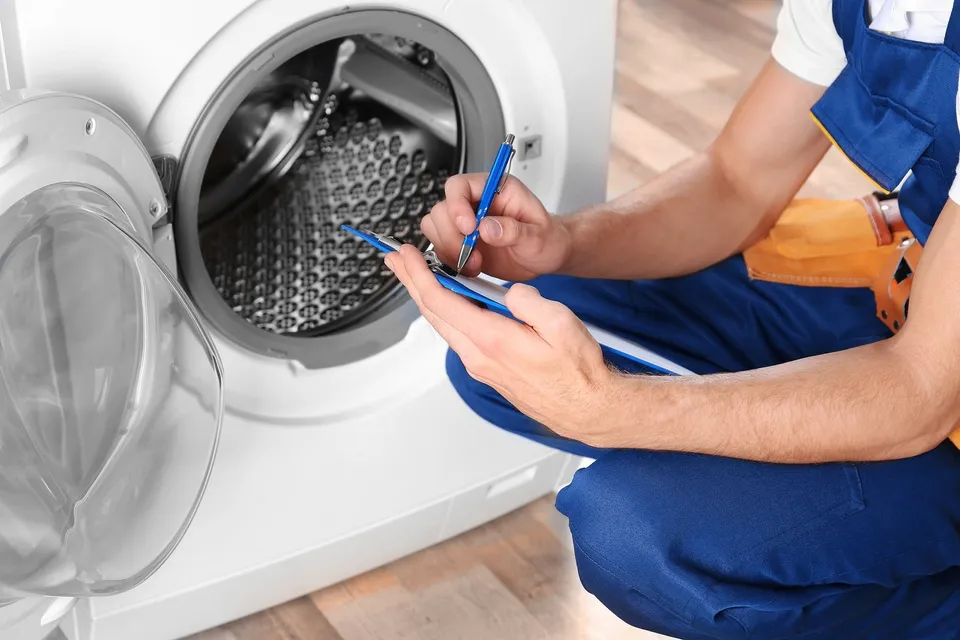
2. Washing Machine Not Spinning
The machine fills and agitates but won’t spin — or spins so weakly it leaves clothes soaking. This is the most common washing machine fault in Melbourne. Most likely causes: a worn drive belt, failed motor brushes, a faulty door/lid switch preventing the spin safety interlock, or simply an unbalanced load triggering an automatic stop.
- Drum turns freely by hand but won’t spin under power — drive belt likely snapped
- Machine makes a humming noise but drum doesn’t rotate — motor or capacitor fault
- Stops mid-spin and won’t restart — check for unbalanced load first
3. Dryer Not Heating
The drum spins and the timer counts down — but clothes come out damp. A dryer not heating is almost always caused by a blown thermal fuse (cuts out when the dryer overheats), a failed heating element, or a clogged vent duct so restricted that the heat safety cutoff activates. See our full guide: dryer not heating Melbourne.
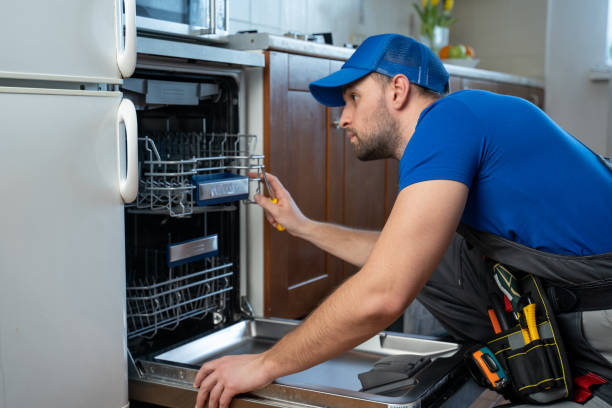
4. Dishwasher Not Draining
Standing water in the bottom of the tub after a cycle. In many cases the fix is simply cleaning the blocked filter — free and takes 5 minutes. If the filter is clean and water remains, the drain pump has failed or an object is jammed in the pump impeller. See our full pricing guide: dishwasher repair cost Melbourne.
- Water remaining after every cycle — clean the filter first
- Pump humming but not draining — pump impeller may be jammed
- No water sound at all — inlet valve or pump may have failed
5. Oven Not Heating Evenly
Food burns on one side, stays raw on the other, or takes far longer than recipes say. Uneven oven heating is usually caused by a partially failed bake element (heating weakly but not fully), a faulty thermostat misreading the temperature, or on fan-forced ovens, a broken fan motor that can no longer circulate heat evenly through the cavity.
- One side of the oven consistently hotter — fan motor or element fault
- Oven takes much longer to reach temperature — thermostat or weak element
- Bottom of food burns but top is underdone — bake element fault
6. Washing Machine Leaking Water
Water on the laundry floor should always be investigated quickly — water damage to flooring and cabinetry adds up fast. Common sources: a torn or hardened door seal on front-loaders, a loose or cracked inlet hose at the back of the machine, or a failed pump seal leaking from underneath during the drain cycle.
- Leak from the front — door seal torn or mouldy
- Leak from the back — hose connection loose or inlet valve fault
- Leak from underneath — pump seal or drum bearing fault
7. Fridge Making Loud or Strange Noises
Clicking, rattling, buzzing, squealing, or loud humming that wasn’t there before. A suddenly noisy fridge indicates something is wearing out. Common sources: a failing evaporator fan (high-pitched squeal inside the freezer), a condenser fan hitting debris at the rear (buzzing or rattling), or a laboring compressor making a loud hum because the condenser coils are clogged.
- High-pitched squeal from inside freezer — evaporator fan bearing failing
- Loud rattling from the back — debris near condenser fan
- Loud constant hum, fridge warmer than usual — dirty condenser coils
- Clicking every few minutes — start relay on compressor failing
8. Dishwasher Leaving Dishes Dirty
Dishes come out with food still on them, a cloudy film, or white calcium deposits. Most often caused by blocked spray arm holes preventing water from reaching surfaces, a failed circulation pump with insufficient water pressure, or a failed heating element running cold water — dishes can’t be properly cleaned without hot water.
- Food still on dishes — spray arms blocked or filter clogged
- Cloudy white film on glasses — calcium buildup from hard water
- Top rack consistently worse — upper spray arm blocked
9. Oven Not Reaching Temperature
Set to 200°C but barely gets above 150°C — or takes 40 minutes to preheat instead of 15. On electric ovens, this almost always means a failed bake element or faulty thermostat. On gas ovens, a weak igniter that can’t fully open the gas valve restricts the flame — the oven technically works but takes far too long to heat. See our guide: oven not heating Melbourne.
- Electric oven slow to heat — element or thermostat
- Gas oven takes very long to preheat — weak igniter
- Oven cycles off too early — thermostat calibration fault
9. Appliance Tripping the Circuit Breaker
You turn on or plug in an appliance and the circuit breaker trips. An appliance that trips the power has an electrical fault and must not be used again until inspected by a licensed technician. Common causes: a motor with failed windings drawing excess current, water ingress into electrical components, a failing capacitor, or damaged internal wiring.
Conclusion
The 10 problems in this guide cover the vast majority of appliance faults Melbourne homeowners face. In almost every case, the fault comes down to a single worn component — and in most cases the appliance is well worth repairing rather than replacing.
DP Electric repairs fridges, washing machines, dryers, dishwashers, and ovens across all Melbourne suburbs with same-day bookings, transparent pricing, and a 90-day warranty. Also see our guides to fridge not cooling, dryer not heating, and same-day appliance repair Melbourne.
Frequently Asked Questions
Appliance Playing Up in Melbourne?
DP Electric repairs all major household appliances same-day across Melbourne. Upfront pricing, 90-day warranty, licensed technicians.
Author bio
Dishank Patel
He is a highly experienced appliance repair specialist and the founder of DP Electric. With a strong commitment to quality service, he provides reliable home appliance repair solutions across Melbourne. From dishwashers and dryers to ovens, cooktops, Refrigerator, washing machines, and air conditioners, Dishank ensures that every repair is handled with precision and efficiency.
Passionate about customer satisfaction, Dishank focuses on delivering prompt and professional service, ensuring appliances function at their best. With years of expertise in diagnosing and fixing a wide range of household appliances, he has built a reputation for excellence and trust in the industry.